
What Is Aseptic Bag-in-Box Packaging? How Gamma Irradiation Works and Why It Matters
If you are evaluating packaging for juice concentrate, fruit puree, dairy ingredients, sauces, or wine, "aseptic"should mean more than a label. It describes a controlled system in which the product, package, filling equipment, and closure work together to prevent recontamination.
Aseptic Bag-in-Box uses a multilayer inner bag and fitment supported by a box, drum, or other container. The bag is pretreated, the product processed separately, and the two meet during controlled filling. Gamma irradiation is one established preparation method.
The practical point for buyers is simple: sterility is a chain of controls, not a feature you purchase by choosing a higher dose or adding another film layer.
What Problem Does Aseptic Bag-in-Box Packaging Solve?
After a liquid product has received its scheduled process, inadequately controlled packaging can introduce microorganisms again. Aseptic packaging is designed to close that gap.
U.S. Food and Drug Administration guidance identifies Bag-in-Box as a system using containers pre-sterilized by gamma irradiation. It also requires control of the fitment, filler, packaging protection, process records, and deviations. A treated bag alone cannot make the finished product commercially sterile.
When the system is validated, some products can move through ambient distribution. A six- or twelve-month shelf-life target is still a project requirement, not an automatic result of gamma treatment. Formulation, pH, process lethality, barrier, seal integrity, and storage determine verified shelf life.
Inside the Package: Bag, Barrier, Fitment, and Outer Container
A useful specification starts with the product, not a preset layer count. The contact layer must seal reliably; the outer web supplies strength; transparent or metallized barriers control oxygen, light, and moisture. The fitment must match both the filling head and dispensing method.
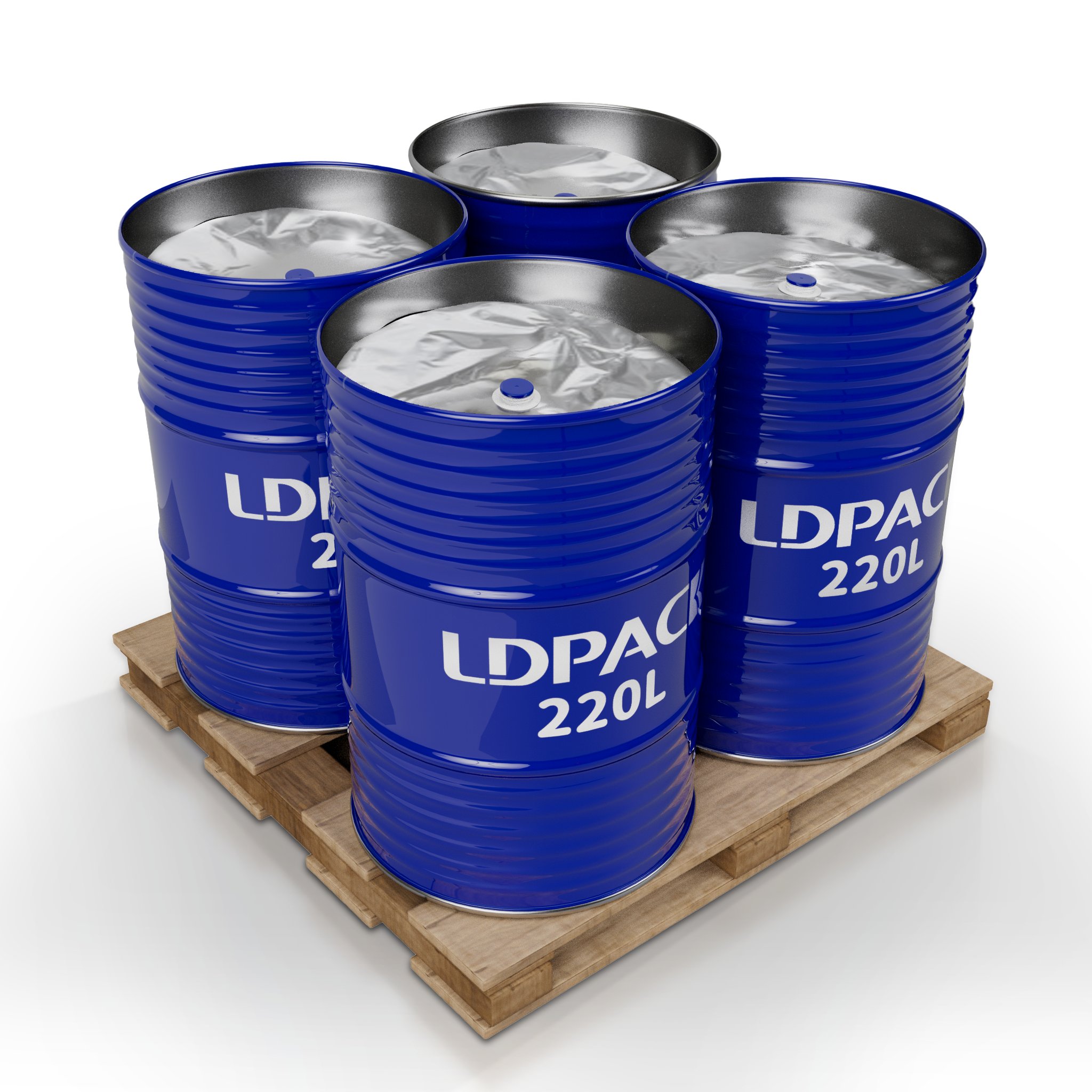
LD PACK's Bag-in-Box range covers 1 L to 220 L across retail, foodservice, and industrial formats. Options include an inner PE layer with an outer laminate, transparent or metallized structures, mono-material PE, and valves for manual, semi-automatic, or automatic filling. The range includes a 220 L aseptic bag-in-drum.
The outer container supports the liquid load and protects against puncture. Keep it free of sharp edges, support the bag during filling, avoid fitment strain, and never pinch the film with the lid.
How Gamma Irradiation Sterilizes the Empty Bag
Industrial gamma processing commonly uses photons emitted by cobalt-60. They pass through sealed transport packaging and transfer energy that damages microbial DNA and other essential structures. At the validated absorbed dose, targeted microorganisms can no longer reproduce.
The process has four characteristics that make it useful for preformed flexible packaging:
- Deep penetration: Photons can reach bags and fitments inside sealed cartons, although density affects dose distribution.
- Terminal package treatment: Bags can be treated after manufacture and protective packing.
- Low thermal load: The process does not rely on high-temperature steam or hot water, but polymers still require testing.
- No chemical sterilant residue: It introduces no peroxide or other sterilant that must be removed.
Gamma treatment is usually applied to the empty bag and fitment, not the liquid food that will later be filled. Confusing package irradiation with food irradiation leads to unnecessary safety concerns and poor process specifications.
What Does a Dose in kGy Really Tell You?
Absorbed dose is measured in gray: 1 Gy equals 1 joule absorbed per kilogram, and 1 kGy equals 1,000 Gy. Technical literature documents 25 kGy treatment for some bulk aseptic bags, while other configurations may use lower validated doses.
That does not make 15 or 25 kGy a universal purchasing specification. A real validation must establish:
- the minimum dose for the microbial-control objective;
- the maximum dose at which bag, seal, and fitment still perform;
- low- and high-dose locations within the packed load;
- a repeatable carton, density, and pallet configuration;
- dosimetry and batch records.
Irradiation affects polymers differently. Do not assume every PE, PA, PET, adhesive, ink, or barrier responds identically. Qualification may include tensile, puncture and seal strength, discoloration, oxygen and water-vapor transmission, migration, and accelerated aging.
Does Gamma Irradiation Make the Bag Radioactive?
No. The package is exposed to gamma photons; it does not become a radioactive source. The International Atomic Energy Agency likewise explains that irradiation does not make exposed food radioactive. Gamma treatment also leaves no chemical sterilant residue on the bag.
The buyer should instead ask: "Has this exact structure been validated across the delivered dose range?"Performance depends on material compatibility, controlled processing, and an intact sterile barrier.
Why Gamma-Treated Aseptic BIB Matters to the Supply Chain
For a food processor, the value appears in four places:
- Protection: A suitable barrier limits oxygen or light while aseptic controls reduce recontamination risk.
- Quality: Separate product and package treatment avoids prolonged post-packaging retort heat, helping protect heat-sensitive qualities.
- Logistics: Empty bags and cartons store flat. Validated shelf-stable products may avoid refrigerated distribution.
- Yield: Fitment and bag geometry control residue. LD PACK's current BIB system is engineered for more than 99% evacuation, including high-viscosity applications.
None of these benefits should be promised from the bag alone. Cold-chain removal, preservative reduction, and shelf-life claims must be supported by the complete filled-product validation.
A Practical 220 L Fruit-Puree Scenario
Consider fruit puree shipped in 220 L drums. It may be oxygen-sensitive, contain particles, and travel through variable temperatures. The specification must connect barrier, fitment flow path, filler compatibility, drum dimensions, irradiation configuration, and transport testing.
LD PACK's 220 L industrial aseptic bag-in-drum supplies the relevant format, multilayer barrier options, and filling-compatible taps. Before scale-up, run an actual filling trial, verify closure integrity, inspect after transport simulation, and confirm product shelf life. This is safer than choosing by film description or unit price alone.
Gamma, E-Beam, or Inline Package Treatment?
| Method | Practical strength | Point to validate |
|---|---|---|
| Gamma | Penetrates sealed, relatively dense loads | Dose mapping, maximum dose, load consistency |
| E-beam | Fast, electrically generated | Lower penetration, density, one- or two-sided exposure |
| Chemical | Can integrate with filling systems | Concentration, coverage, contact time, residuals |
| Steam/heat | Familiar thermal process | Material resistance, cold spots, exposure time |
There is no best method in isolation. The correct choice depends on package geometry, film structure, filler design, target microbial control, volume, and local regulatory requirements.
What Should Buyers Ask a Bag-in-Box Packaging Manufacturer?
Before approving a custom aseptic BIB, ask for answers to these questions:
- Why is this film structure suitable, and what are its barrier-test conditions?
- Which fitment drawing and filling-head interface apply?
- What validated irradiation range and load configuration will be used?
- How are treated lots protected and traced?
- What destination-market food-contact documents are available?
- Which seal, puncture, transport, and aging tests support the design?
- Can samples run on the production filler before scale-up?
Where irradiation indicators are used, check them against the supplier's written instructions before opening the protective packaging. Keep cartons dry and intact, and do not use bags from damaged or uncertain lots until the supplier has investigated them.
Choosing the Right System with LD PACK
Established in 1990, LD PACK reports more than 25,000 tons of annual flexible-packaging capacity. Its research institute develops high-barrier, mono-material, and recyclable structures, supported by automated pouch-making and spout-inserting lines.
Our view as a bag-in-box packaging manufacturer is that customization begins with operating conditions, not a catalog code. Share product type, pH, viscosity, particles, fill temperature, volume, shelf life, market, filler, fitment drawing, and annual demand so the complete system can be developed together.
FAQ
Q1. Is every Bag-in-Box package aseptic?
A: No. Standard BIB may package wine, oils, or detergents without being aseptic. An aseptic system requires a suitably treated package, separately processed product, controlled filling, and verified closure.
Q2. How long does aseptic Bag-in-Box packaging last?
A: There is no universal answer. Shelf life depends on product processing, formulation, barrier, seal integrity, distribution temperature, and validation. Test the filled product under realistic conditions.
Q3. Can a mono-material PE bag be gamma treated?
A: Potentially, but recyclability and irradiation compatibility are separate. Evaluate the PE formulation, seal, barrier, dose range, aging behavior, and local recycling infrastructure.
Q4. What should I send to request a custom quotation?
A: Provide product and process details, volume, outer-container dimensions, barrier target, filler/valve information, quantity, market, and required documents. Follow with a sample or pilot filling trial.
Conclusion
Gamma irradiation is valuable because it can prepare sealed, preformed bags for aseptic filling without chemical sterilant residue or a high-temperature package treatment. Its success, however, depends on validated dose delivery, compatible materials, protected handling, filler-fitment compatibility, and a verified product process.
For a custom 1–220 L solution, contact LD PACK with your product and filling-line parameters to review the appropriate bag structure, barrier, fitment, and sample-validation plan.