
Principles and Applications of Retort Pouch
Food brands considering shelf-stable meals often ask whether a flexible pouch can replace a can or jar. The more useful question is whether the food, thermal process, pouch structure and distribution plan are a good match.
A retort pouch is a hermetically sealed flexible package designed to go through a validated heat process after filling and sealing. For many low-acid foods, the goal is commercial sterility: controlling microorganisms to a level that supports safe, stable storage under the intended conditions. It is not a claim that every microorganism is eliminated, and it is not achieved by packaging alone.
For ready meals, soups, sauces, wet pet food and rice, the pouch is part of a food preservation system. This guide explains how thermal processing works, how material choices affect performance, where retort pouches fit best and what to ask a retort pouch manufacturer before requesting samples.
How Retort Pouch Sterilization Works
Microorganisms are progressively inactivated when food is heated above their growth range. The required time and temperature combination is established for the specific food, package, retort system and market by qualified technical personnel.
After filling and sealing, pouches are loaded into a retort for controlled heating, cooling and inspection. References commonly describe processing around 116 to 121°C, while the food, pouch dimensions, fill weight, headspace and equipment determine the scheduled process.
A simple distinction helps prevent costly misunderstandings:
- Boiling or pasteurization around 100°C is not automatically a shelf-stable retort process.
- Retort processing is commonly associated with pressurized thermal treatment and may operate at or around 121°C, depending on the product.
- Higher-temperature retort conditions can be used in some applications, but a more demanding cycle requires every component of the pouch, including seals and fitments, to be assessed for that exact condition.
The package must remain sealed while the food and trapped gases expand. FDA guidance notes that overpressure can be critical for flexible pouches because it helps maintain the container profile during processing. Align product characteristics, the scheduled process, pouch construction and storage conditions before specifying the bag.
Retort Pouch Materials: Each Layer Has a Job
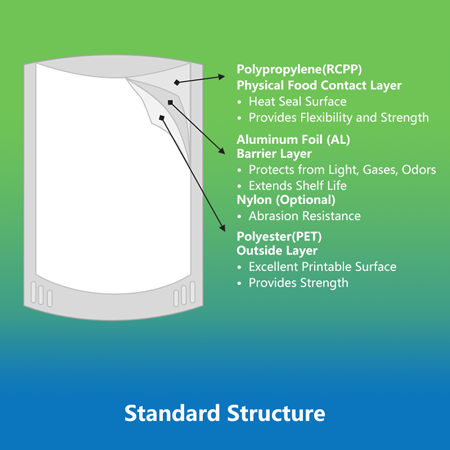
Most retort pouches use laminated or co-extruded structures. A conventional opaque structure may combine an outer layer, adhesive, aluminum foil barrier and CPP heat-sealing layer. The arrangement must match the food, retort and shelf-life requirements.
|
Layer function |
Common material route |
What it needs to achieve |
|
Outer surface |
PET or a suitable polyamide layer |
Heat resistance, scuff resistance and printability |
|
Mechanical support |
Polyamide or another structural layer |
Puncture and flex-crack resistance where needed |
|
Barrier |
Aluminum foil, EVOH or a qualified transparent barrier |
Protection from oxygen, light, moisture and aroma loss |
|
Food-contact sealant |
Retort-grade PP or CPP |
Reliable heat sealing under the selected process |
PET contributes strength and printability. Aluminum foil provides a light and gas barrier, while polypropylene provides a heat-seal and food-contact surface. Nylon can add toughness; transparent options can use other barrier technologies.
Foil offers light and gas protection but removes visibility. Transparent structures can improve shelf appeal, but their barrier performance must match the shelf-life target.
For China supply discussions, GB/T 10004-2008 is the published national standard for dry-laminated and extrusion-laminated plastic packaging films and pouches. It is a packaging-material standard, not a substitute for product-specific food-contact, migration, retort or shelf-life validation.
Where Retort Pouches Are Used
Retort packaging is useful when a product needs ambient distribution, convenient portions and a flexible format. Common applications include ready meals, soups, rice, sauces, meat, seafood and wet pet food.
|
Application |
Main packaging concern |
Question before sampling |
|
Soups and sauces |
Seal contamination and product flow |
Are particulates, oil content and filling temperature defined? |
|
Ready meals and rice |
Moisture retention and eating quality |
What shelf life and reheating experience does the brand need? |
|
Meat and seafood |
Puncture resistance and barrier protection |
Could bones, shells or sharp edges stress the pouch? |
|
Wet pet food |
Seal reliability during processing and distribution |
What pouch format, fill weight and handling conditions apply? |
|
Baby food or fruit puree |
Food-contact suitability, spout performance and barrier control |
Is the spout and cap validated with the whole pouch system? |
Low-temperature treatment can preserve texture in some foods, but may not deliver the ambient shelf life needed for wider distribution. Retorting can extend shelf stability, although excessive heating can affect texture, colour and flavour.
A chunky sauce may need more mechanical support; a smooth soup may place more emphasis on filling and barrier performance. Start with the product's failure risks, not a popular bag style.
Choosing Between Conventional and Mono-PP Retort Pouches
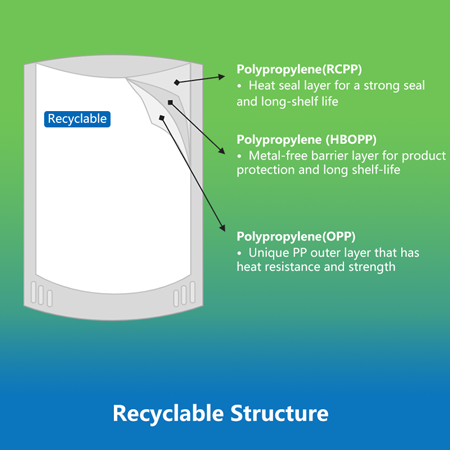
Traditional retort laminates balance printability, toughness, barrier performance and heat sealing. Mono-material PP routes simplify the material mix and can support recycling goals where suitable systems exist.
|
Decision factor |
Conventional laminated route |
PP-based mono-material route |
|
Barrier design |
Can use foil or other dedicated barrier layers |
Uses PP-compatible barrier technology selected for the application |
|
Product visibility |
Often opaque when foil is used |
May offer non-metallic options, depending on the structure |
|
Recycling objective |
More complex material mix |
Designed to simplify material composition |
|
Development question |
Is the selected laminate appropriate for the process and shelf life? |
Can the needed retort, barrier and seal performance be achieved within the material design? |
LDPACK's published recyclable pouch information describes a PP mono-material route with at least 90 percent PP and a stated condition of up to 121°C for 30 minutes. The actual structure, closure, food and validated process must be confirmed before production.
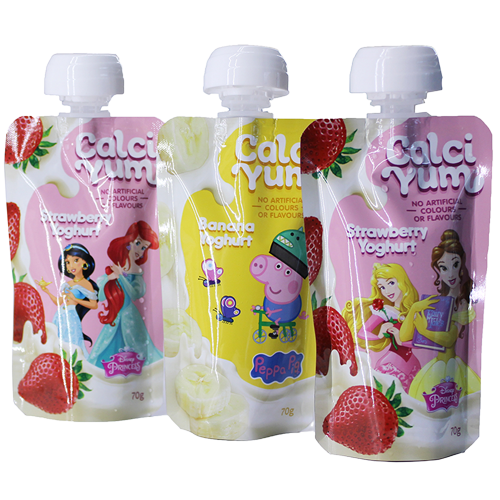
Stand-up and spouted pouches can suit sauces, tuna, wet pet food, fruit puree and ready meals. The spout and cap must be assessed as part of the same packaging system.
Request the complete test context for material data. An OTR value needs units, test method, temperature, humidity and the exact pouch structure.
How to Decide Whether Your Product Is a Good Candidate
Before asking for a quotation, prepare a short product brief. It will help the manufacturer propose a more relevant structure and reduce repeated sampling.
- Define the product's pH, water activity, viscosity, oil content and particle characteristics.
- Confirm pouch size, fill weight, headspace and preferred format, such as flat, stand-up or spouted.
- Identify the retort system and scheduled process, or the qualified party that will develop it.
- Set the required shelf life, storage conditions, sales channels and export markets.
- State whether the brand needs opacity, visibility, easy opening, a spout or a recycling-oriented material route.
- Agree on sample evaluation, including seal integrity, thermal processing, barrier performance and distribution handling.
This turns a price-only enquiry into a product and performance discussion. Shelf life is not only a film specification. It also depends on the food, headspace, process, seal quality and storage conditions. A recycling objective must likewise be assessed alongside the required retort and barrier performance.
What to Ask a Retort Pouch Manufacturer
Price matters, but a useful manufacturer conversation should cover more than price. Ask which structures are proposed and why, which relevant food-contact and quality documents are available, how seal integrity and heat resistance will be assessed, which pouch formats and printing options can be supported, and what details are required before a production trial.
LD PACK offers retort pouch formats for ready meals, soups, wet pet food and recyclable-oriented applications. Buyers can start with the Retort Pouch product range, then submit a product brief that explains the food, pouch size, process conditions and intended market. This gives the technical team a better basis for discussing material structure, samples and validation.
For products sold in the United States, processors of shelf-stable low-acid or acidified foods in hermetically sealed containers may have registration and process-filing obligations. A pouch is included within this regulatory concept even though it is not a metal can. Brands should involve a qualified process authority and confirm the requirements for every target market before commercial launch.
Aluminum-plastic composite films consist of multiple laminated layers, typically three layers, with a typical structure of the surface layer/adhesive/aluminum foil/adhesive/heat-sealing layer (CPP). These packaging films are used widely with advantages such as an attractive appearance, excellent mechanical properties, high barrier, high-temperature resistance, and good hygiene. However, they also have some disadvantages, including the hardness and brittleness of aluminum foil, which is not as flexible as plastic films. The plastic film used for high-temperature retort pouches must meet the requirements of retorting conditions and content features, to determine the selection, specifications, combinations of materials, types of inks, adhesives, etc. Common plastic film materials include BOPET, BOPA, HDPE, RCPP, AL, co-extruded EVOH, co-extruded PVDC, and co-extruded PE etc. There are also multi-layer co-extruded films with five or more layers, such as PP/Tie/EVOH/Tie/PP and PP/Tie/PA/EVOH/PA/Tie/PP. In addition, there are co-polyamide MXD6 and ceramic vapor-deposited films like SiOxPET12. However, due to technical and cost constraints, the application of multi-layer co-extruded films and ceramic vapor-deposited films in high-temperature retort pouches is not yet widespread.

Initially, LD Pack's high-temperature retort pouch were developed in accordance with GB/T10004-1988 standards, which included only one material structure: PET/AL/CPP for cooking conditions limited to 121°C for 40 minutes. Ten years later, it was revised to GB/T10004-1998 "Retort Composite Films and Bags," which expanded the material structure to include PET/CPP, PA/CPP (two-layer transparent types), PET/AL/CPP, PA/AL/CPP (three-layer opaque types), and PET/PA/CPP (three-layer transparent types), as well as PET/ALPACPP (four-layer opaque types). Physical and mechanical properties of the products were enhanced by adding resistance to media, peel strength and heat-sealing strength after cooking as performance indicators, while the original oil resistance indicator was removed to emphasize the product's practicality in withstanding high-temperature retorting. After another revision in 2002, high-temperature retort pouch were incorporated into the latest standard, "General Principles for Packaging Composite Films and Bags."
FAQ
Q1. Can every food be packed in a retort pouch?
A: No. Suitability depends on the food, process, packaging structure and intended market. A qualified process authority should determine the thermal process for shelf-stable products.
Q2. Are retort pouches microwave-safe?
A: It depends on the structure and usage instructions. A pouch containing aluminum foil should not be placed directly in a microwave. Where required, transfer the food to a microwave-safe container.
Q3. What temperature should a retort pouch withstand?
A: There is no universal number. Published references commonly describe processing around 116 to 121°C, while the correct conditions depend on the validated product, pouch and process.
Q4. Can a Mono-PP retort pouch replace a conventional laminate?
A: It may be an option for selected applications, but it should be evaluated against the required barrier, heat resistance, seal performance, shelf life and local recycling pathway.
Q5. What information should be sent with a quotation request?
A: Provide the food type, product characteristics, pouch size, fill weight, process information, target shelf life, sales market, estimated order volume and any requirements for printing, format or recyclability.
Start With a Better Development Brief
A retort pouch can support a convenient shelf-stable format, but it should be selected as part of the product system. Define the food, process, distribution needs and sustainability target first. Then share those details with a manufacturer that can discuss material structure, samples and validation in practical terms.
For a custom project, visit LDPACK Retort Pouch or Recyclable Retort Pouch and submit the product details that affect performance. A well-prepared brief leads to a more useful sample plan than a price-only enquiry.