
LDPACK Guild on How to Choose the Right Bag-in-Box Structure and Fitment for Liquid Products
Bag-in-Box (BIB) packaging has become a mainstream solution for liquid products across food, beverage, dairy, culinary, and industrial sectors, thanks to its lightweight design, cost efficiency, space-saving storage, eco-friendly attributes, and residue-free dispensing. Unlike rigid packaging, a complete BIB solution is an integrated system built on customized packaging structures and matched functional fitments.
Most BIB packaging failures—including liquid leakage, product spoilage, short shelf life, poor dispensing performance, and logistics damage—stem from mismatched structural design and improper fitment selection, rather than production or transportation errors. Many packaging buyers and engineers rely on generic standard structures and universal spouts, ignoring product characteristics, filling processes, and end-use scenarios, which leads to compromised packaging stability and wasted costs.
This guide focuses entirely on BIB structural design and fitment matching rules, sorting out scenario-based selection standards, common pitfalls, and system matching logic to help liquid brands build stable, cost-effective, and sustainable customized BIB packaging solutions.
Core Selection Principle: Structure & Fitment Serve Product Scenarios
There is no universal standard BIB structure or one-size-fits-all fitment for all liquid packaging needs. The optimal solution is always tailored to the core attributes of the liquid product and its full lifecycle application scenarios, including product sensitivity, viscosity, target shelf life, production filling conditions, logistics and storage environments, and end-user dispensing habits.
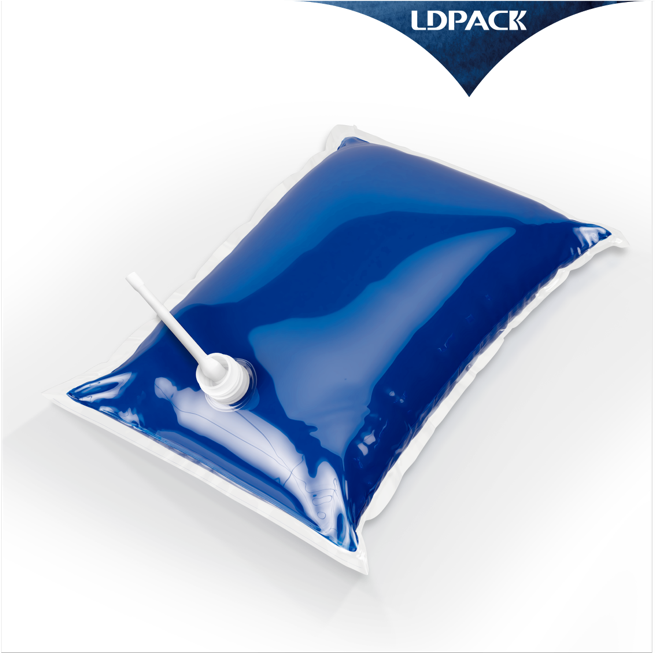
High-oxygen-sensitive wine and juice require high-barrier integrated structures to lock freshness and flavor; high-viscosity sauces and syrups demand structural cooperation with special flow-guided fitments to avoid residue and blockage; large-capacity industrial liquids need reinforced anti-pressure and anti-drop structural designs. Any isolated structural or accessory selection will break the overall balance of the BIB system and affect final packaging performance.
How to Select Optimized BIB Packaging Structures (5 Core Criteria)
BIB packaging structure refers to the overall integrated design of the inner containment system, barrier protection system, mechanical bearing system, and sealing structure. It determines the product protection capability, production adaptability, and logistics durability of the entire package. The following five dimensions are the core basis for structural customization.
1. Customize Barrier Structure Based on Product Sensitivity
Barrier performance is the core functional attribute of BIB structures, mainly resisting oxygen infiltration, light irradiation, and moisture exchange to avoid liquid oxidation, discoloration, flavor deterioration, and quality attenuation.
High-sensitivity liquid scenarios (red wine, fresh juice, pasteurized dairy, aroma concentrates, premium edible oil): Adopt multi-layer composite high-barrier structures, which can effectively block oxygen and ultraviolet light, extend ambient shelf life, and lock product freshness. For products with strict light-proof requirements, metallized barrier structural design is available to achieve dual protection of oxygen and light isolation.
Low-sensitivity liquid scenarios (stable sauces, common edible oil, industrial lubricants, cleaning liquids): Adopt conventional single-layer or simple composite general structures. Excessively high-barrier structures will increase material complexity and packaging costs without bringing practical quality improvement.
Barrier structural design must be matched with actual shelf life goals, filling residual air volume, and long-term storage temperature to avoid performance redundancy or insufficient protection.
2. Optimize Mechanical Structure for Capacity & Logistics Scenarios
BIB structures need to withstand continuous external pressure during stacking, long-distance transportation vibration, extrusion friction, and accidental impact, as well as internal liquid gravity and flow impact. Mechanical structural stability directly determines the pass rate of logistics and storage.
For small and medium-capacity BIB packages (1L–10L), conventional standard mechanical structures can meet daily transportation and handling needs. For large-capacity industrial and commercial packages (10L–220L), liquid load increases exponentially, so it is necessary to adopt reinforced tensile, puncture-resistant, and crack-proof structural design, optimize the overall stress distribution of the inner container, and avoid local stress concentration leading to breakage and leakage.
It is a common misunderstanding that thicker structural materials equal better performance. Reasonable multi-layer structural optimization can achieve higher mechanical stability with lighter materials, realizing lightweight packaging and cost control.
3. Guarantee Sealing Structural Integrity to Eliminate Hidden Dangers
The sealing structure is the weakest link in the entire BIB system and the key barrier to prevent liquid leakage and external contamination. Unreasonable sealing structural design or mismatched sealing processes will lead to weak seals, edge cracking, and slow leakage, triggering product loss, contamination complaints, and brand losses.
High-quality BIB structural design will target product attributes and production equipment parameters to customize sealing width, sealing strength, and anti-aging sealing structure. It is necessary to complete real-machine filling and sealing tests in the actual production environment before mass production, verify the stability of the sealing structure under high-speed filling, constant temperature storage, and alternating cold and hot conditions, and eliminate hidden dangers that cannot be detected by laboratory data alone.
4. Match Structural Specifications with Production Filling Processes
An excellent BIB structure must be highly compatible with the brand's existing production lines. Unmatched structural size, inner container stretching degree, and reserved fitment position will lead to low filling efficiency, inaccurate positioning, and high defective rates in mass production.
Structural customization needs to fully adapt to filling temperature (cold filling/ hot filling), filling speed, sterilization process, and equipment operating parameters. For high-temperature hot-filled liquids and sterilizable products, the structure needs high-temperature resistance and anti-deformation design to ensure no structural damage or performance attenuation during sterilization and filling.
5. Balance Structural Performance, Cost & Recyclability
Modern BIB structural design needs to balance three core indicators: functional performance, comprehensive cost, and sustainable recyclability. With the global upgrading of green packaging standards, simplified structural design has become an inevitable trend.
On the premise of meeting barrier, mechanical and sealing performance requirements, priority should be given to simplified single-material integrated structures to reduce redundant composite layers, lower material costs, and adapt to mainstream PE recycling systems. Avoid over-designing complex composite structures, which not only increase packaging weight and costs but also reduce packaging recyclability and fail to meet brand carbon reduction and green certification needs.
Mainstream BIB Structural Types & Applicable Scenarios
1. High-Barrier Composite BIB Structure
Composed of multi-layer functional composite materials, integrating oxygen barrier, light resistance, moisture resistance, and mechanical protection. It features ultra-low oxygen and light transmittance, stable sealing performance, and long-term anti-aging ability.
Applicable products: Wine, sparkling juice, fresh dairy products, aroma-sensitive concentrates, premium liquid ingredients, and other high-value and easily deteriorated liquids requiring long shelf life.
Scenario advantages: Effectively lock product flavor and color, resist external environmental interference, and support long-term ambient storage.
2. Recyclable Mono-Material BIB Structure
Adopts a mono PE integrated structure, with high barrier options, it maintains basic barrier and mechanical performance while having recyclable properties, low carbon, and environmental protection.
Applicable products: Edible oil, stable fruit syrup, daily chemical liquids, general industrial liquids, and other products with medium and low barrier requirements.
Scenario advantages: Low comprehensive cost, compliant with global recyclable packaging standards, helping brands complete green packaging upgrading.
3. Reinforced Heavy-Duty BIB Structure
Optimized for large-capacity and harsh logistics scenarios, with enhanced tensile, puncture resistance, drop resistance, and compression resistance. The overall structural stress is uniform, and it can bear heavy liquid pressure for a long time.
Applicable products: 10L–220L large-capacity industrial liquids, catering bulk sauces, concentrated raw materials, and products requiring long-distance and multi-turn logistics.
BIB Fitment Selection: Match Accessories with Structure & Product Attributes
If the BIB structure determines the basic protection capability of packaging, fitments (valves, spouts, taps) determine filling efficiency, dispensing experience, and product utilization rate. Structural design and fitment selection must be synchronized and matched; a high-performance structure paired with mismatched fitments will still lead to poor packaging performance.
1. Core Matching Standard: Product Viscosity
Liquid viscosity is the primary factor for fitment selection, which directly affects flow smoothness, dispensing uniformity, and residual liquid rate:
- Low-viscosity liquids (wine, juice, edible oil, purified water): Match standard small and medium-caliber spouts and self-closing valves, with smooth and stable flow, no dripping, and suitable for rapid filling and daily dispensing.
- High-viscosity liquids (tomato sauce, syrup, puree, thick concentrates): Must match customized large-diameter flow channels and anti-blocking valve structures. Cooperate with optimized BIB internal structural guidance to reduce liquid adhesion, avoid blockage, and improve product evacuation rate.
Water simulation test data is not credible. High-viscosity products must complete real-machine dispensing tests with actual materials to verify fitment and structural matching.
2. Select Fitment Type by Dispensing Scenario
- Civil manual dispensing: Simple rotary self-closing taps, anti-drip design, easy to operate, suitable for small and medium-capacity household and retail packaging.
- Commercial catering fixed dispensing: Constant-flow quantitative valves, stable single outflow, standardized metering, suitable for chain catering and beverage service scenarios.
- Industrial automated filling & pipeline dispensing: Special interface adaptive fitments, compatible with automated equipment, supporting high-speed filling and pipeline continuous discharge.
3. Production Compatibility Matching
Fitment specifications, insertion methods, and sealing structures must be compatible with BIB overall structure and production line parameters. Before finalization, verify filling speed, filling temperature, sterilization resistance, and sealing matching degree. Small mismatches will cause batch defective products and reduced production efficiency in mass production.
System Synergy: BIB Structure, Fitment & Outer Box Integrated Matching
BIB packaging is a closed-loop system, and all components are interrelated and restrictive. The inner container structure, barrier design, fitment position, and outer carton bearing capacity need overall customized coordination:
- Adjust fitment installation position and flow channel size according to BIB capacity and internal structural stretching range;
- Optimize sealing process parameters according to structural material characteristics to avoid structural damage during sealing;
- Match outer box compression resistance and size specifications according to internal structural bearing capacity and logistics stacking mode;
- Unify the overall structure to meet recyclable design standards and reduce redundant accessories and composite materials.
Only overall system optimization can avoid single-performance redundancy and overall structural loopholes.
Industry-Specific BIB Structure & Fitment Selection Cheat Sheet
Targeted selection priorities for mainstream liquid industries to quickly lock customized solutions:
| Application Industry | Core Structural Priorities | Fitment Matching Focus |
| Wine & Alcoholic Beverages | High oxygen barrier, aroma locking, anti-oxidation, stable structure | Special anti-corrosion wine tap, slow uniform flow, anti-drip |
| Fruit Juice & Beverages | Oxygen & light dual barrier, fresh-keeping, food safety structure | Standard self-closing spout, avoid secondary pollution |
| Dairy Products | High-clean sterile structure, anti-bacterial, anti-oxidation, sterilization resistant | Food-grade hygienic valve, suitable for cold & hot filling |
| Sauces & Condiments | High structural toughness, anti-adhesion, high sealing stability | Large-caliber anti-blocking fitment, high evacuation rate |
| Syrups & Concentrates | Pressure-resistant and anti-deformation structure, long-term stable barrier | Flow-controllable valve, adjustable dispensing volume |
| Edible Oils | Light-proof and anti-oxidation structure, oil corrosion resistance | Drip-proof spout, convenient for repeated opening and closing |
| Industrial Liquids | Reinforced mechanical structure, anti-leakage, wear-resistant and durable | High pull-out resistance fitment, suitable for harsh logistics |
Key Parameters to Provide for Accurate Customization
To help your brand obtains a fully matched BIB system solution, what are needed: complete product and production parameters: liquid viscosity, pH value, oil content, oxygen/light sensitivity, target shelf life, packaging capacity, filling temperature/speed, sterilization requirements, logistics and storage conditions, and sustainable packaging goals. Comprehensive parameter input is the premise of accurate structural and fitment customization.
Conclusion: System Customization Is the Core of BIB Liquid Packaging
Choosing BIB packaging for liquid products is not a simple selection of materials and accessories, but a systematic customization centered on structural design and fitment matching. Blindly pursuing high barrier, thick structure, or universal accessories will only lead to performance redundancy, cost waste, or packaging failure.
A qualified BIB solution needs to balance structural protection performance, production line adaptability, end-user dispensing experience, logistics durability, sustainable recyclability, and comprehensive cost. As a professional integrated BIB packaging manufacturer, LDPACK provides 1L–220L full-range customized structural solutions, covering high-barrier anti-corrosion structures, recyclable mono-material structures, heavy-duty reinforced structures, and supporting scenario-adaptive fitments, helping liquid brands solve all packaging pain points.
Contact LDPACK now to customize exclusive BIB structures and fitment solutions according to your product characteristics and application scenarios.
FAQs
Q: What is a standard BIB packaging structure?
A: A complete BIB structure is an integrated system composed of inner containment, barrier protection, mechanical support, and sealing structure, matched with professional fitments and outer cartons, used for safe storage and dispensing of liquid products.
Q: How to choose the best BIB structure for liquid packaging?
A: There is no universal best structure. The optimal solution is customized according to product sensitivity, viscosity, shelf life requirements, production processes, and logistics scenarios.
Q: Does a thicker BIB structural design mean better performance?
A: No. Excessively thick structures increase costs and reduce recyclability. Optimized structural design can achieve higher stability with lighter materials.
Q: Can BIB structures adapt to high-viscosity liquid packaging?
A: Yes. By optimizing the internal flow-guiding structure and matching special anti-blocking fitments, BIB systems can perfectly adapt to sauces, syrups, and other high-viscosity products.
Q: Are mono-material BIB structures recyclable?
A: Simplified mono-material structures have good recyclable potential. The final recyclability depends on the overall packaging system and local recycling infrastructure standards.